

I spent three weeks in the Bay Area from mid-February to early March. The first week was a road trip with my 13-year-old daughter: Monterey Aquarium, Los Angeles for a Lady Gaga concert, Warner Bros. Studios, the Sphere in Las Vegas, then back up to Mountain View. The remaining two weeks she attended the German International School of Silicon Valley while I was on a project assignment in San Jose.
In between: the Computer History Museum, an AWS Startup Event in San Francisco, catching up with friends at Applied Intuition and Zoox, a guest lecture at Stanford on innovation culture, Alcatraz, Golden Gate Bridge, an NBA game, and rides in both Waymo and Zoox robotaxis.
This is what stuck with me after getting back to Germany.
The robotaxi reality
After the NBA game on Monday night, my daughter and I walked out and the street was full of robotaxis. Not a few. The majority of vehicles picking people up were driverless. It looked like a scene from a movie, except it was a regular weeknight in San Francisco.

Waymo already covers a massive radius, from San Francisco in the north all the way down past Mountain View. You open the app, a car shows up, nobody is sitting in the front seat, and it drives you where you need to go.
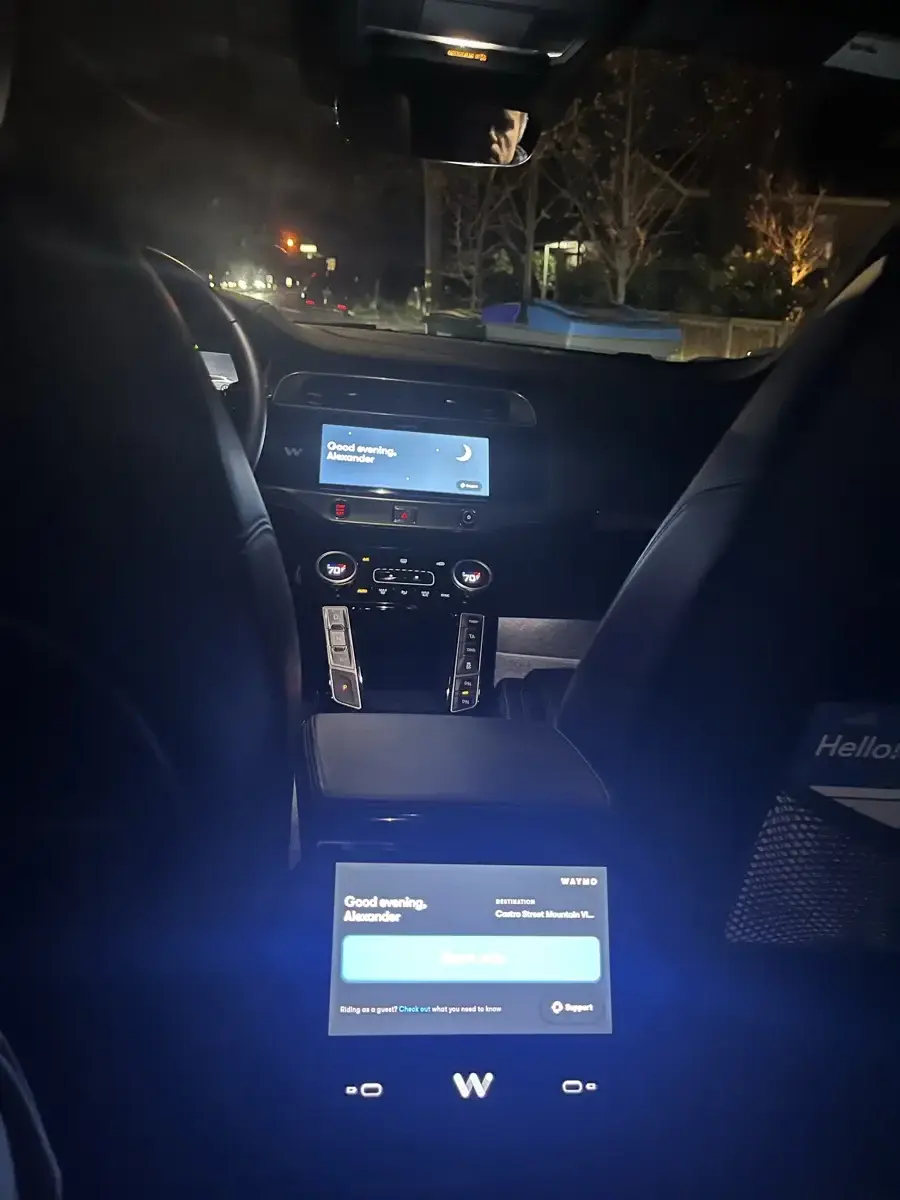 In February 2026, Waymo raised $16 billion at a $126 billion valuation. They are completing over 400,000 rides per week across six US metros, with 15 million rides in 2025 alone and 127 million autonomous miles driven. They plan to expand to 20+ cities in 2026, including Tokyo and London.
Zoox operates in a much smaller area, one district in San Francisco, and currently only for family and friends of employees. Different stage, same direction.
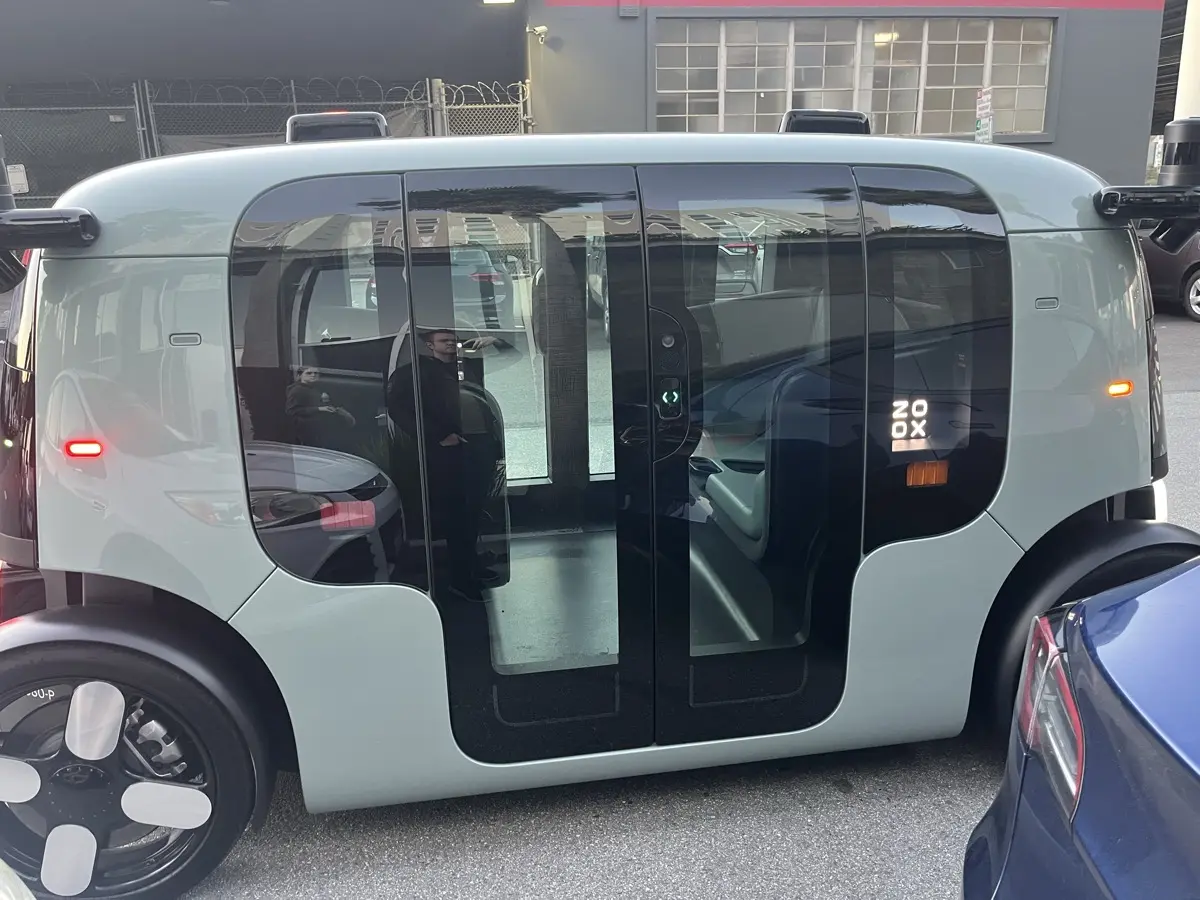
In the ADAS world we talk about five levels of autonomous driving. European OEMs are currently shipping Level 2+ and selectively Level 3: the car takes over more, but there is still a steering wheel, still a human in the loop, not yet fully unsupervised. What you see on the streets of San Francisco is Level 4 running in production. Every day. At scale.
The innovation formula
At the Computer History Museum, one thing became very clear to me. Looking at decades of technology history, every breakthrough required the same three ingredients: a real problem to solve, talent, and funding.
 If any one of those is missing, it stays a hobby project.
The Bay Area has all three in absurd density. There are hackathons and tech events nearly every day. You feel the energy. You see it on the highway billboards, which in 2026 are almost exclusively about AI and agentic workflows.

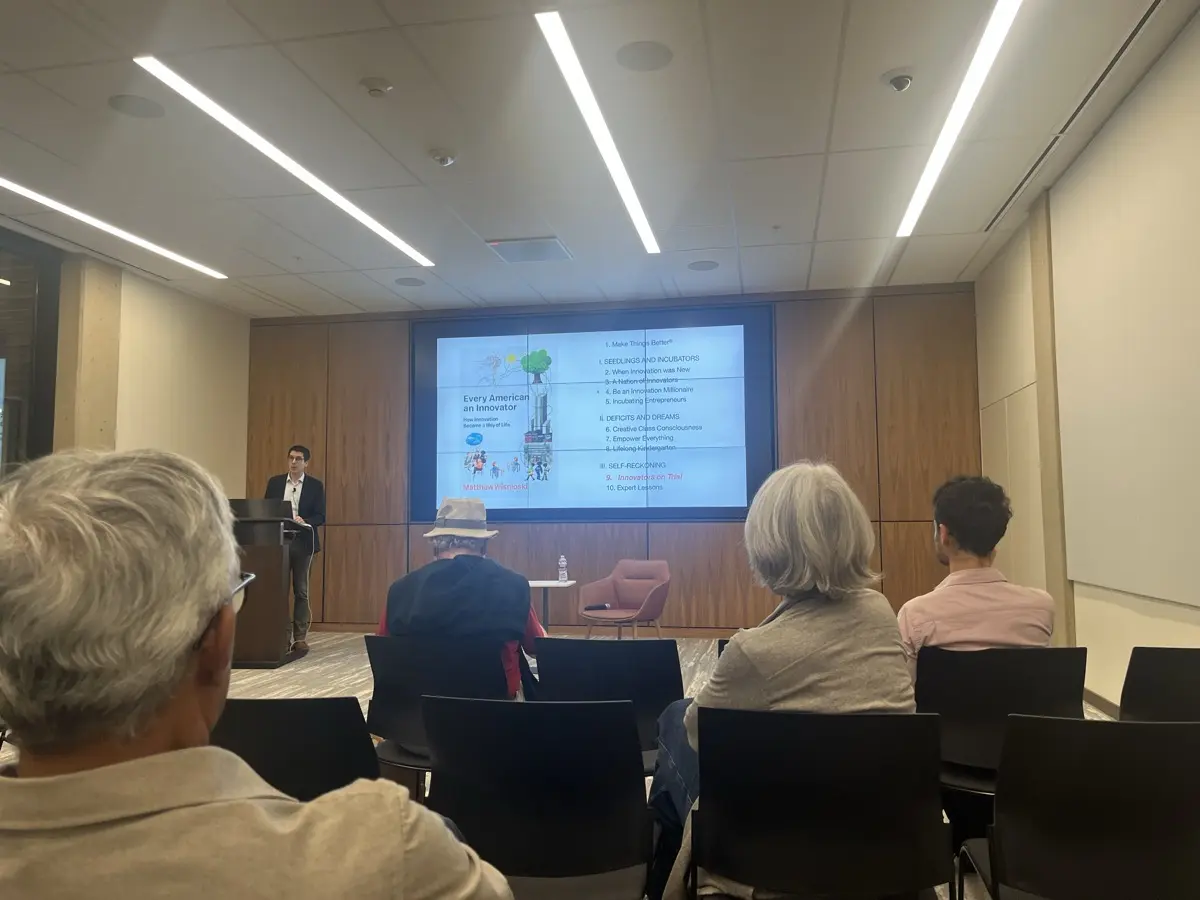
One Thursday evening my daughter and I attended a lecture at Stanford by Matt Wisnioski, whose book “Beyond the Buzzword” traces a critical history of innovation. It reinforced the same point: Silicon Valley’s innovation culture is not accidental. It is the result of these ingredients concentrated in one place over decades.
What Europe gets wrong about AI
Here is where it gets uncomfortable. In my experience, the conversation about AI in European management is dominated by efficiency. How many agents does it take to match one FTE? How can we use benchmarks and studies to gain leverage in negotiations? Maybe squeeze out 10-20% productivity gains?
That is fine as far as it goes. Efficiency matters. But it is only one dimension. What I observed in the Valley is different: people are not trying to do the same things cheaper. They are trying to do things that were previously impossible. New business models, new products, new ways to reach customers. The difference between optimizing what you have and building what does not exist yet.
I keep coming back to this point, and I know it sounds repetitive, but AI is not a bubble. The financial markets may be overheated, but the underlying capability is real. The robotaxis outside the arena are running commercially, at volume, every night of the week.
The levels of agentic AI
The ADAS analogy applies directly to how companies adopt AI today. Several frameworks have formalized this, most notably Feng, McDonald & Zhang’s L1-L5 model mapping user roles from Operator to Observer, and the Cloud Security Alliance’s six-level structure for enterprise governance. The pattern is the same across all of them.
Level 2 is where most organizations are: copy-paste workflows with AI chat interfaces. You ask a question, you get an answer, you manually do something with it.
Level 3 is where things get interesting: you give the AI tools, feedback loops, and more time to reason. It starts acting semi-autonomously within guardrails. This is where agentic coding tools, automated research workflows, and tool-using assistants live today.
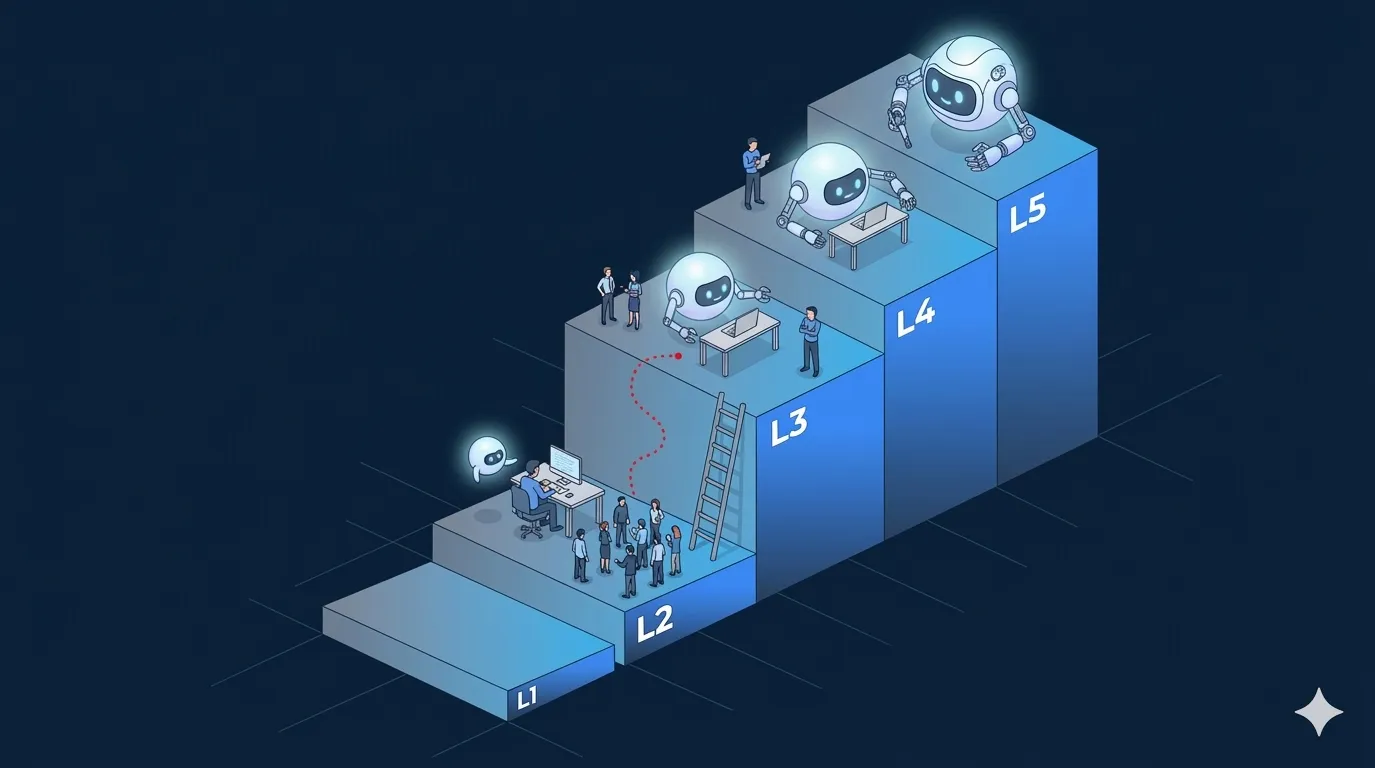
The step from Level 2 to Level 3 looks small on paper. It is not. At Level 2 the human does the work and the AI assists. At Level 3 the AI does the work and the human supervises. That inversion changes everything: how you structure prompts, how you provide context, how you evaluate output, how you handle failure. You cannot get there by using a chat interface harder. You need different tooling, different workflows, and a fundamentally different understanding of what the AI needs from you. Most organizations underestimate this because the demos look easy. The demos always look easy.
Levels 4 and 5, fully autonomous agents that you slot into your org chart, is what many executives dream about. But if the jump from 2 to 3 is already this hard, the path to full autonomy is not a smooth ramp. It is a staircase where each step requires solving a different class of problem.
Context is king. Knowledge management is a decades-old problem, but AI gives it new urgency. The models know what is on the public internet. They do not know your company’s processes, your tribal knowledge, your undocumented decisions. Bridging that gap, turning implicit knowledge into something an AI can use, is the actual hard problem. And nobody has solved it yet.
The cost
Innovation in Silicon Valley has a price that is easy to underestimate from Europe.
My daughter’s two weeks at the German International School gave me a firsthand look at what families there deal with. Tuition and living costs are steep. I covered it privately, and it hurt. The people who work at the top companies earn well, but the commitment expected in return is extreme. Weekends are not sacred the way they are in European office culture. Labor laws are different. The pace is relentless.
Maybe that is the price. The robotaxis driving around San Francisco at night did not build themselves during business hours.
What I took home
Three ingredients for innovation: real problems, talent, funding. Europe has the problems and increasingly the talent. The funding and the willingness to think beyond efficiency is where we fall behind.
AI adoption is not linear. The jump from Level 2 to Level 3 is harder than it looks, and most companies are still at the beginning of that jump. The organizations that figure out how to contextualize their internal knowledge for AI will have an advantage that compounds.
And if you get the chance: take a robotaxi ride yourself. The future lands differently when you see it on the street instead of reading about it in a strategy deck.